




- Home
- >
- Risks and Opportunities Shaping Australia’s Construction Industry in 2026
Risks and Opportunities Shaping Australia’s Construction Industry in 2026
Australia’s construction industry enters 2026 at an inflection point. Capital is returning, but selectively, and projects are filtered by feasibility rather than paused by shock. Momentum is returning across the country particularly where delivery capacity and capital discipline are balanced.
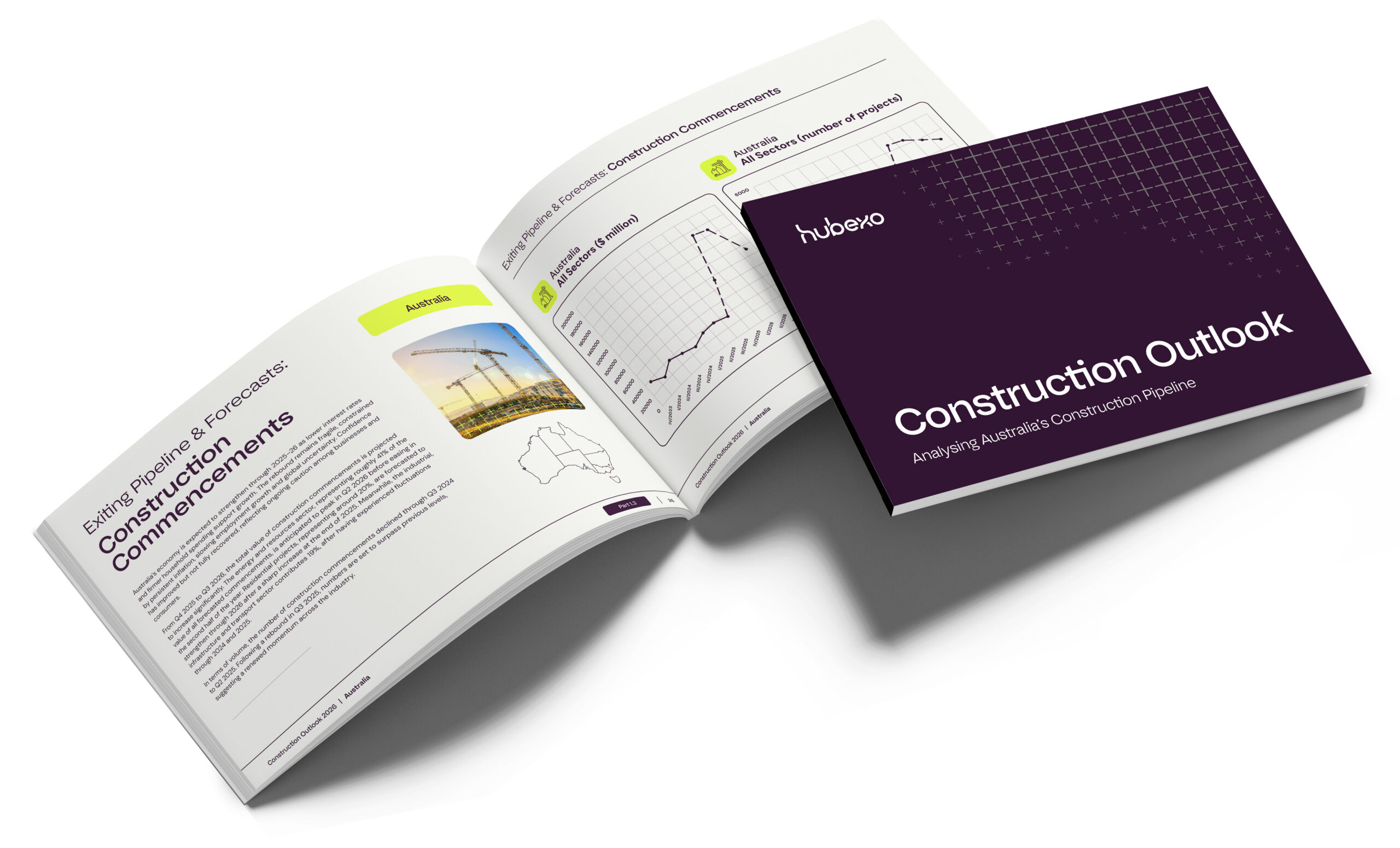
Australia’s construction pipeline is regaining momentum. Early-stage project values jumped more than 60% quarter-on-quarter in late 2025, driven by energy and resources and a lift in residential activity. Looking ahead, commencements are set to rise through 2026, with volumes recovering even as labour and capacity constraints continue to shape delivery.
What does the future hold for Australia’s construction industry?
By analysing LeadManager pipeline data in Hubexo’s Construction Outlook for 2026, a clear picture emerges of how the market is absorbing pressure and where momentum is rebuilding.
The report tracks project activity across key building sectors and regions, revealing how resilience has shifted since late 2023 and where capacity, capital and confidence are beginning to realign.
Beyond the data, the Construction Outlook is grounded in insight. It brings together findings from Hubexo’s annual sentiment survey with exclusive perspectives from industry leaders and decision-makers navigating risk, responding to constraints and shaping the strategies that will define the next phase of growth.
Contributors included:
- Australian Strategic Policy Institute, Deputy Director, National Security Program, Raelene Lockhorst
- Architectus, CEO, Ray Brown
- BESIX Watpac, Chief Executive Officer, Mark Baker
- Carr, Director, Stephen McGarry
- Cedar Woods, State Manager – Victoria, James Bovell
- Chapter Two, Director, Jon Quayle
- Coronation, Managing Director, Joe Nahas
- CLARA Energy, Director, ESG & Program Delivery, Geoff Gourley
- Decode, Group CEO, Divya Mehta
- Figurehead Construction, Founder & Managing Director, Joe Grasso
- Growthbuilt, General Manager, Adam Ashcroft
- Hickory, Managing Director, George Abraham
- Mosaic Property Group, Founder & Managing Director, Brook Monahan
- Okana ANZ, Director, Claire Bowles
- Plus Studio, Director, Michael McShanag
- Robar Civil Group, Director, Ronan Egan
- Slattery, Director, Carbon Planning, Tom Dean
- Third.i Group, Director & Co-founder, Luke Berry
- Warren & Mahoney, Studio Principal, Daryl Maguire
- WilkinsonEyre Australia, Director, Ed Daines
5 Key Trends Shaping the Australian Construction Sector
Here are five key risks influencing the Australian construction industry extracted from the latest edition of Hubexo’s Construction Outlook 2026.
- Early-stage momentum builds in core sectors
- Deferrals and abandonments ease as capital begins to flow
- 2026 is shaping as a delivery year—but under constraint
- Feasibility and capital access now define who can build
- Digital capability has become a resilience factor
Early-stage momentum builds in core sectors
The national pipeline is rebuilding from the front end. In Q3 2025, the total value of project proposals rose more than 60% quarter-on-quarter, led by energy and resources alongside renewed residential activity. This reflects projects re-entering the system after feasibility resets, rather than speculative expansion.
“What’s coming is a 2026 delivery wave as projects finally break ground—but the limited labour pool is struggling to keep pace. That tension defines this cycle”, Hubexo, President, APAC, Ashleigh Porter, said.
“Firms aren’t debating technology anymore; they’re demanding tools that cut risk and fragmentation. Opportunities are out there, but they won’t be won with yesterday’s systems.”
Deferrals and abandonments ease as capital begins to flow
Deferral and abandonment rates have eased to manageable levels nationally, signalling improving market stability. Projects are no longer stalling by default; they are being filtered more deliberately, with clearer funding, scope and risk parameters.
Survey data shows this easing is underpinned by steadier workloads and improving alignment between capital availability and project feasibility.
“The market is consolidating towards developers who can deliver large, complex projects with in-house capabilities, diversified risk management and clear governance frameworks”, Joe Nahas, Managing Director, Coronation, said.
2026 is shaping as a delivery year—but under constraint
Construction commencements are forecast to rise between Q4 2025 and Q3 2026, with energy, residential and infrastructure driving activity. In volume terms, project numbers are expected to surpass recent levels, though labour and capacity constraints remain binding.
“Across all markets, the industry is navigating significant challenges—driven largely by rising construction costs, stretched government budgets and a constrained skilled labour pool”, BESIX Watpac, Chief Executive Officer, Mark Baker said.
“We’re seeing contraction in New South Wales and Victoria, largely due to reduced public expenditure.”
Feasibility and capital access now define who can build
Across stakeholder disciplines, feasibility scrutiny has intensified. Capital is available, but more conditional—often flowing through private credit, institutional partners and joint venture structures.
“Early market engagement is critical to mitigating risks”, Cedar Woods, State Manager – Victoria, James Bovell said.
“Involving trusted contractor partners at the outset from acquisition of a site enables buildability and programme challenges to be identified upfront, supports value management initiatives to meet budget parameters and reduces pricing uncertainty”.
Digital capability has become a resilience factor
Technology adoption is no longer framed as innovation, but as protection against margin erosion, delay and fragmentation. Builders, in particular, are entering 2026 with greater confidence tied directly to data visibility, coordination and risk management.
“Technology is reshaping the way we build and we’re seeing the benefits flow directly into housing delivery”, Decode, Group CEO, Divya Mehta said.
“We have been embedding digital tools more deeply into delivery. AI-driven scheduling, drones for site monitoring and advanced platforms strengthening efficiency, safety and transparency across the entire project cycle.”
Want to learn more about the current state of the Australian construction industry?
Dive deeper by downloading this year’s Hubexo Construction Outlook.
AS SEEN: