




- Trang Chủ
- >
- Risks and Opportunities Shaping New Zealand’s Construction Industry in 2026
Risks and Opportunities Shaping New Zealand’s Construction Industry in 2026
As New Zealand’s construction industry enters 2026, it is becoming a more selective market, where only projects with manageable risk are moving forward.
New Zealand’s construction pipeline is tightening but stabilising. Early-stage projects are entering at a measured pace, while deferrals and abandonments remain elevated as capital and delivery constraints filter the pipeline. Construction commencements are forecast to lift gradually through 2026, led by projects with secure funding and clearer delivery pathways.
What does the future hold for New Zealand’s construction industry?
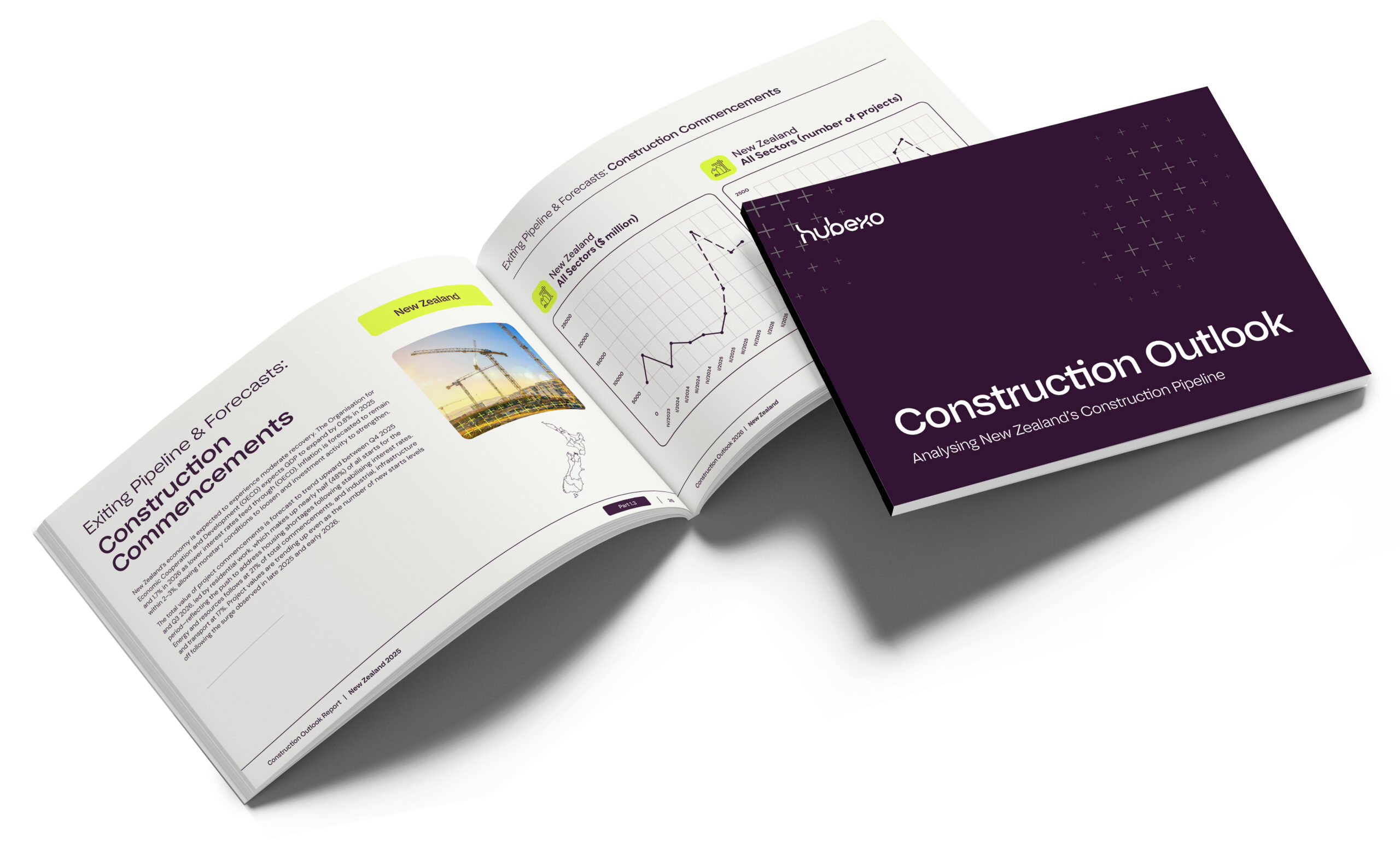
By analysing LeadManager pipeline data in Hubexo’s Construction Outlook for 2026, a clear picture emerges of how the market is absorbing pressure and where momentum is rebuilding.
The report tracks project activity across key building sectors and regions, revealing how resilience has shifted since late 2023 and where capacity, capital and confidence are beginning to realign.
Beyond the data, the Construction Outlook is grounded in insight. It brings together findings from Hubexo’s annual sentiment survey with exclusive perspectives from industry leaders and decision-makers navigating risk, responding to constraints and shaping the strategies that will define the next phase of growth.
Respondents included:
- Aotea Group, Commercial Manager, Garth Jones
- Building Institute Aotearoa, Chief Executive, Kirsten Magnusson
- D&H Steel Construction, Managing Director, Wayne Carson
- Fosters, Director, Leonard Gardner
- Generation Homes, Chief Executive, Craig Hopkins
- Hawkins, Executive General Manager, Craig Treloar
- Kalmar, Director, Bert Denee
- Maycroft, Chief Executive, Grant Gunn
- McConnell Dowell, Managing Director, Fraser Wyllie
- New Zealand Defence Force, General Manager Delivery, Walter Butt
- New Zealand Institute of Architects, Chief Executive, Mark Abbott
- Ockham Residential, Chief Executive Officer, William Deihl
- Peddlethorp, Director, Manuel Diaz
- RTA Studio, Executive Director, Founder, Richard Naish
- Sheppard & Rout, Director, Jasper van der Lingen
- Summerset, Chief Construction Officer NZ, Dean Tallentire
- thinkstep-anz, Chief Executive Officer, Barbara Nebel
- Waide Commercial Construction Limited, Managing Director, Charlie Waide
- Warren and Mahoney, Principal, John Coop
- Wolfbrook, Chief Executive, Guy Randall
5 Key Trends Shaping the New Zealand Construction Sector
Here are five key risks influencing the New Zealand construction industry extracted from the latest edition of Hubexo’s Construction Outlook 2026.
- Early-stage momentum builds in core sectors
- Deferrals and abandonments remain elevated
- Construction activity expected to return gradually
- Capital discipline is shaping what gets built
- Delivery capacity the limiting factor
Early-stage momentum rebuilds selectively
New Zealand’s pipeline is stabilising from the front end, with early-stage activity continuing at a measured pace rather than accelerating. Fewer projects are entering the pipeline, but those that do are better defined and more closely aligned with funding and delivery capacity.
This reflects a market recalibrating around feasibility rather than volume, as sponsors prioritise projects with clearer pathways to commencement.
“The tension shaping New Zealand right now isn’t demand, it’s capacity”, Hubexo, President APAC, Ashleigh Porter said.
“The need for housing, infrastructure and essential upgrades is undeniable, but labour, capital and delivery bandwidth are the binding constraints. That’s why leading firms are tightening feasibility and leaning on technology to remove friction.”
Deferrals and abandonments remain elevated
Abandonment rates remain elevated, while deferrals, though lower than previous peaks, are beginning to inflect. Capital constraints, planning friction and delivery risk are forcing marginal projects out earlier in the pipeline, easing downstream volatility but tightening the overall volume of activity.
“Confidence is the commodity most in short supply. Demand exists and capacity exists, but the key challenge is the cost equation”, Warren and Mahoney, Principal, John Coop said.
“That is why we focus on efficiency and lean design while ensuring our solutions endure and provide long-term value.”
Construction activity expected to return gradually
Construction commencements are forecast to recover across 2026. Volumes are expected to improve from recent lows, though capacity constraints will limit the speed of recovery.
“Last year’s mantra across the industry was ‘survive until 25’. Now it has simply become ‘survive until 26, thrive in 27’”, Generation Homes, Chief Executive, Craig Hopkins said.
“The target keeps moving, and the uncertainty is the hardest part. Nobody can say with confidence when the bounce-back will come.”
Capital discipline is shaping what gets built
Across developers and builders, feasibility scrutiny has intensified. Capital remains available, but more conditional, often flowing through private credit, institutional partners and joint venture structures. Projects unable to withstand extended approval timelines or cost sensitivity are falling away earlier in the cycle.
“The most critical levers are planning and consent reform to reduce bottlenecks, smarter procurement that rewards innovation and whole-of-life outcomes, and alternative funding models to unlock capital and partnerships across public and private sectors”, Waide Commercial Construction Limited, Managing Director, Charlie Waide said.
Delivery capacity the limiting factor
Labour availability, contractor capacity and sequencing risk are now the primary constraints on activity. Even where demand exists, delivery capability is determining pace and scale. Firms with strong execution discipline, coordinated supply chains and realistic programs are best positioned as the market stabilises.
“The labour market remains one of the most structural risks we face”, McConnell Dowell, Managing Director, Fraser Wyllie said.
“When unemployment is higher in New Zealand than in Australia, the flow of talent across the Tasman is inevitable and, in most cases, it is one-way traffic. Very few make the return journey.”
Want to learn more about the current state of the New Zealand Construction Industry?
Dive deeper by downloading this year’s Hubexo Construction Outlook.
AS SEEN: